Our team successfully operated on the first case in the world where a neurogenic cough was cured by a unilateral decompression of the vagus nerve (MVD surgery). We hope this new syndrome will become known as Vagus Associated Neurogenic Cough Occurring due to Unilateral Vascular Encroachment of the Root. This acronym, VANCOUVER syndrome, is an homage to the city where this discovery was made.
Here is a link to our original paper published in the Journal of Otology, Rhinology & Laryngology.
Here is a link to our recently published paper in the Frontiers of Neurology.
What is Neurogenic Cough?
Neurogenic cough is a chronic cough caused by changes in the nerves of the throat or lungs. It is not caused by any of the usual causes of chronic cough such as gastric reflux, asthma, eosinophilic bronchitis, post-nasal drip, rhinosinusitis, or medications. Some cases of neurogenic cough are due to nerve damage or hypersensitivity following a viral illness.
We believe that some cases of neurogenic cough can be caused by a blood vessel pinching or compressing the vagus nerve. This is VANCOUVER syndrome.
How does VANCOUVER syndrome cause cough?
The analogy we use for the tickling sensation in your lungs that causes chronic cough in VANCOUVER syndrome is the tingling sensation in your hand that occurs when you hit your ‘funny bone’ – or bang your ulnar nerve at the elbow. There is nothing wrong with your hand but the nerve from your hand (the ulnar nerve) has been hit at the elbow and sends signals to the brain which are interpreted as tingling in your hand. The same thing can happen with your vagus nerve. If the vagus nerve is hit or pinched, it will send signals to the brain which are felt like a tickling sensation in your lungs. The vagus nerve normally carries a tickling sensation from the lungs and only fires when a foreign object enters the lungs. This is the normal cough reflex. If the vagus nerve fires inappropriately – not because something entered the lungs but rather because the nerve itself was pinched- you get VANCOUVER syndrome. The brain interprets the signals coming from the ‘pinched’ vagus nerve as a tickling sensation in the lungs and triggers a cough.
We can potentially cure this chronic cough by finding where the vagus nerve is pinched and decompressing it. There could be a lot of people with neurogenic cough that do not have VANCOUVER syndrome and we want to be sure we do not operate on them. Over the last two years we tried a variety of tests and believe the appropriate diagnostic tests are as follows:
How to Diagnose VANCOUVER Syndrome
Patients with VANCOUVER syndrome describe an intermittent tickle deep in their throat or chest. The sensation triggers an irresistible cough. The symptoms can get better with anti-neuralgia medications – the same medications that would help trigeminal neuralgia (e.g. carbamazepine, gabapentin). Our diagnostic protocol (click for paper) has been published and we use 1. MRI and 2. inhaled nebulized lidocaine as screening tests.
The initial screening test is an MRI to look for the compression or pinch of the vagus nerve. If there is no compression of the nerve, there is no VANCOUVER syndrome. If there is a compression of the vagus nerve then it COULD be VANCOUVER syndrome and an additional screening test is needed. There are some people who have what looks like a vagus nerve compression on the MRI but are completely asymptomatic – a compression of the vagus seen on the MRI is therefore necessary but not sufficient for a diagnosis of VANCOUVER syndrome. The next screening test is inhaled lidocaine.
Lidocaine is a local anesthetic and can stop a nerve from transmitting its signals. Inhaled nebulized lidocaine should stop the tickling sensation by anesthetizing the vagus nerve endings in the throat and lungs. With no tickling sensation, the coughing should stop for the duration of the anesthetic (an hour or so). This is a relatively simple test, familiar to most ENT specialists, and we use this as the second screening test. If that test works (i.e. the sensation to cough is gone for the duration of the anesthetic), then we proceed with more sophisticated tests to determine if you have VANCOUVER syndrome. If that screening test does not work, we know the patient does not have VANCOUVER syndrome.
The next step is to determine which vagus nerve is affected. There is a right and left vagus nerve and it is very likely that only one is compressed. Some patients can feel which side the tickling sensation is coming from. If that side corresponds to the side with the vagus compression seen on MRI, then the patient can consider surgery (see MVD surgery below). If the patient can not feel which side is affected, then we use a vagus nerve block to confirm the affected side.
Our protocol for unilateral vagus nerve block has been published (click for paper). We determine which vagus is affected by anesthetizing one at a time. When a vagus nerve is anesthetized, it can no longer send tickling information to the brain. It also can not send information to the vocal cords and so the voice is temporarily hoarse. Patients have a unilateral vagus nerve block (ultrasound guided procedure in the neck). If the patient’s voice becomes hoarse then we know the vagus nerve has been anesthetized successfully. If the tickling sensation and coughing stops then we know it was that vagus nerve causing the cough. When the voice returns to normal as the anesthetic wears off (about 90 minutes later), the coughing should return. A week later, the patient returns to have the other side done – this should have no benefit on the cough because VANCOUVER syndrome is one sided. We use this extra test to be certain the problem is one-sided. If there is a blood vessel compressing the vagus nerve on the same side that the anesthetic was effective, then we will consider offering surgery to try and cure the condition. The surgery is called microvascular decompression of the vagus neve or MVD of the Xth nerve.
Surgery
MVD is a common neurosurgical proceed used to decompress the trigeminal nerve for trigeminal neuralgia or the facial nerve for hemi-facial spasm. Our centre has performed over 1,000 of these operations for these two conditions. The same principles are used to decompress the vagus nerve for VANCOUVER syndrome. The risks of MVD are best discussed directly with your neurosurgeon as results will vary depending on their experience.
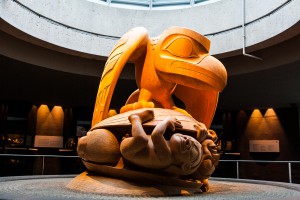
The Haida artist, Bill Reid, carved The Raven and the First Men and it is on display at the Museum of Anthropology in Vancouver. It depicts the Haida’s interpretation of human creation. I believe this statue is also symbolic of the birth of VANCOUVER syndrome. A condition that has been around a long time but only recently recognized.