Dr. Honey’s book, The Tenth Nerve, has been published by Penguin Random House Canada. It is available at Amazon, Indigo, local bookstores and drchrishoney.com. The book is an homage to several patients who taught him more about medicine than any lecture or textbook.
The 16th World Congress of the International Neuromodulation Society (INS) was held in Vancouver May 2024. Professor Honey was the Chairman of the Congress and hosted 1,300 clinicians and researchers.
The 3rd World Congress on MVD neurosurgery was hosted in Vancouver July 2022. Dr. Honey was the President of this Society (2019-2022) and hosted the meeting.
Our sentinel paper describing the world’s first recognized case of HEmi-LaryngoPharyngeal Spasm or HeLPS was published in the Journal of Neurosurgery (in July 2016).
Our paper demonstrating the connection between glossopharyngeal neuralgia and HELPS was published in Neurosurgery (in December 2019). It also discovered 27 previous descriptions of patients with HELPS, unrecognized at the time, from six different countries in four different languages.
Dr. Amanda Hu, in collaboration with Professor Murray Morrison, has published a paper reviewing the diagnosis of HELPS for otolaryngologists. This was published in 2020 in the Annals of Otology, Rhinology, & Laryngology.
HELPS syndrome is a condition caused by a blood vessel pinching the nerve rootlets of the Vagus nerve (the Xth cranial nerve). It is similar to the well recognized hemifacial spasm syndrome but the nerve involved is the Vagus instead of the Facial nerve. As a result, the symptoms are episodic throat contractions and cough. The throat contractions typically become stronger and more frequent over the years and can lead to a terrifying inability to breath or choking sensation. Patients may end up in the Emergency Department being intubated or with a permanent tracheostomy because of their inability to breath during a severe episode. Some but not all of our patients can tell which side of their throat (left or right) contracts during a choking episode. In between these choking episodes, patients feel normal.
Physicians unfamiliar with this condition may misdiagnose HELPS syndrome as a psychiatric conversion disorder, a response to gastric reflux, or laryngeal dystonia. One identifying feature is that the spasms eventually occur while sleeping. Another feature of this condition is that it is associated with coughing episodes. These coughing spells usually begin as a response to a tickling sensation at the back of the throat. In response to this tickling sensation, the patient will cough. This coughing tends to get stronger over the years and eventually can be so severe that it causes dizziness (“seeing stars”), vomiting or urinary incontinence. Our patients have described various triggers for this coughing including environmental odors, prolonged or loud talking but it can also occur spontaneously without any obvious cause. Eventually the coughing will occur while sleeping.
Diagnosis
The diagnosis of HELPS syndrome requires a history of intermittent choking and coughing. We have published our guidelines for the diagnosis of this condition (see above paper). Obvious causes need to be excluded including acid reflux, exposure to airborn irritants, conversion disorder and dystonia. Laryngoscopy can sometimes see a unilateral twitch of a vocal fold following vocalization. This is pathognomonic and not seen in any other condition. The choking will be reduced by unilateral botulinum toxin (Botox) injections on the side of the problem but will have no effect on the opposite side. These tests should be spaced in time to give the vocal fold time to recover completely from the first injection before trying the second side. If there is a unilateral response to the Botox injections and an MRI demonstrates a vessel encroaching on the vagus nerve on the same side, then neurosurgery can be discussed.
Treatment
Patients can be treated with repeated Botox injections. The throat spasms will still occur but will be much less severe. These injections typically need to be repeated every three months. This will not stop the coughing because the tickling sensation continues. The coughing may respond to anti-neuralgia medications such as carbamazepine or amitriptyline. If patients want an opportunity for a definitive cure, then the pinched vagus nerve must be decompressed surgically. This operation is called a microvascular decompression (MVD). Many neurosurgeons will be familiar with the MVD operation for trigeminal neuralgia (Vth cranial nerve), hemifacial spasm (VIIth cranial nerve), or glossopharyngeal neuralgia (IXth cranial nerve). The operation is essentially the same except the nerve being decompressed is the Vagus (Xth cranial nerve).
During the world’s first successful operation to cure this condition, we saw that two of the rootlets forming the patient’s Vagus nerve were severely stretched by a loop of the posterior inferior cerebellar artery (see Figure 1 below). After we freed the rootlets from some scar tissue, one of them fell back into the normal position (see Figure 2 below). We then moved the artery slightly to free up the second rootlet (see Figure 3 below). The patient did well with no surgical complications and has not had another episode of HELPS in over 4 years.
Figure 1:
The top two of the five rootlets making up the Vagus nerve (cranial nerve X) in this patient were obviously distorted by the posterior inferior cerebellar artery. The glossopharyngeal nerve (cranial nerve IX) was not affected.
Figure 2:
After freeing up some scar tissue around the rootlets, one of them fell back into the normal position. We then moved the artery slightly to take the pressure off the other affected rootlet.
Figure 3:
At the conclusion of the operation, all the nerve rootlets were safely decompressed.
Listen to a patient describe their symptoms
We are very grateful to our patients for sharing their stories. In the video below, “Patient #2” describes his HELPS syndrome before and 8 months after MVD surgery.
.
Future Work
First, we are working to clarify the diagnosis of this condition. It is likely that patients will present with slight variations of symptoms and we want to understand what are the common themes (e.g. throat contractions and cough) and what are the less commonly associated problems (e.g. changes in voice or a feeling of a fat tongue). We also want to understand what is the best method of conclusively diagnosing this condition. We believe that the unilateral vocal fold twitch described in our paper is unique to this condition. Not all patients will have this (or it will not be present during the examination). A unilateral improvement in throat contractions following Botox with no improvement on the other side is suggestive of a unilateral problem. If the MRI shows a vessel encroaching on the vagus nerve on the same side then that is highly suggestive of HELPS on that side.
Second, we are working to educate our colleagues around the world that HELPS exists and can be cured. This will be done with publication of our work in peer-reviewed journals and presentations at scientific conferences. Our peer-reviewed papers (see above) are available for our colleagues to read and learn about HELPS syndrome. We have presented our first case to our North American neurosurgical colleagues at the American Society for Stereotactic and Functional Neurosurgery (ASSFN) in June 2016 and presented our first four cases to our European colleagues at the European Society for Stereotactic and Functional Neurosurgery (ESSFN) meeting in September 2016. Our first five cases were presented to the World Society for Stereotactic and Functional Neurosurgery (WSSFN) at their quadrennial meeting in Berlin June 2017 (on the last lecture of the final day of the meeting!). Dr. Honey has also presented this work as an invited guest at the 4th annual Russian Federation of Stereotactic & Functional Neurosurgery meeting in Moscow (May 2018) and as a guest of the Iranian Neurosurgical Society (May 2018).
Third, although the surgical cure will lie in the hands of neurosurgeons, the diagnosis (and thus access to care) will depend on our ENT and Emergency Medicine colleagues. We will have to educate them as well about HELPS. It is unfortunate that all our patients were told at one time during their illness that they had a psychiatric illness. This is a misdiagnosis but a common medical error when the physician does not recognize the illness. The stress of being misdiagnosed can lead to anxiety for our patients. They tend to avoid any food or activity that happened to precede their last severe episode and therefore they can develop some obsessive-compulsive traits. Finally, being told “it’s all in your head” can make some patients angry. The combination of anxiety, obsessive-compulsive traits and anger can mislead a psychiatrist into believing that the patient does have a psychiatric disorder. VANCOUVER syndrome is a physical illness and it has a surgical cure.
Ultimately, we need other centers to be able to recognize and treat this condition.
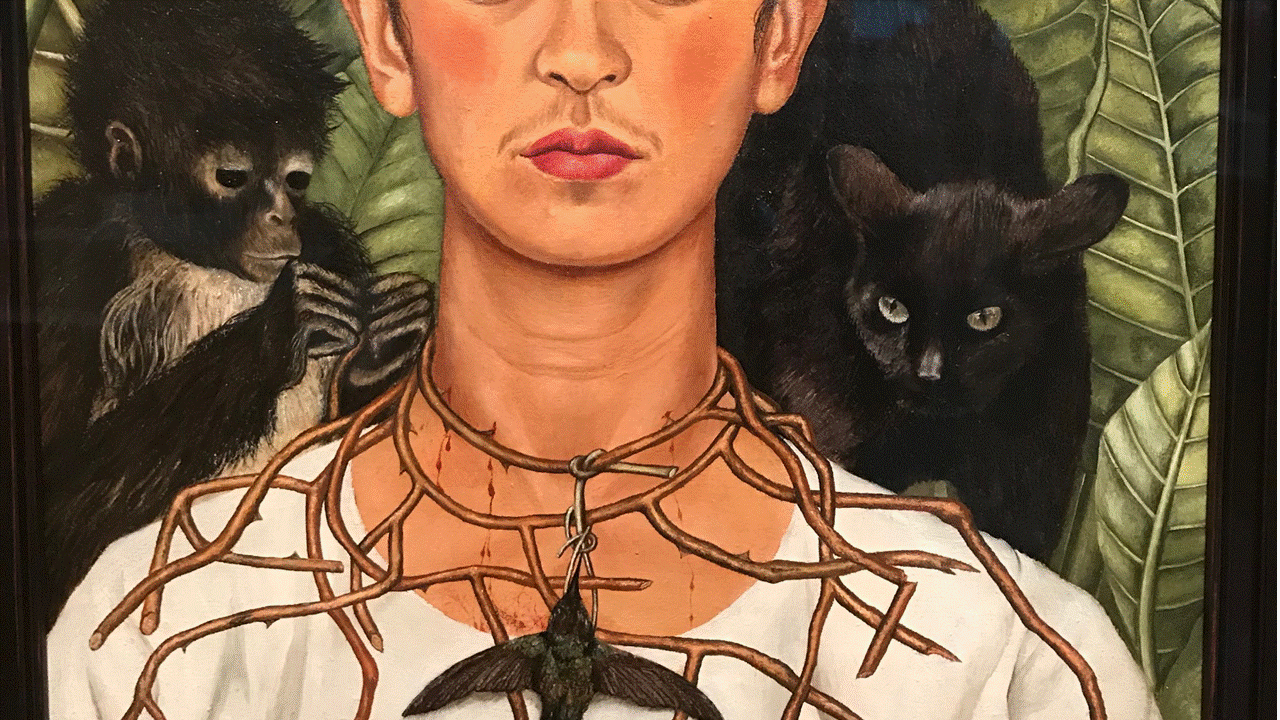
The picture below is a close-up of a self portrait by Frieda Kahlo entitled “Self portrait with thorn necklace and hummingbird” (Autorretrato con collar de espinas y colibrí ) from 1940. The constricting necklace reminds me of the throat contractions of hemi-laryngopharyngeal spasm.
As reviewed on our Parkinson’s Disease page, tremor is rhythmic shaking. It can be caused by Parkinson’s Disease, Multiple Sclerosis, stroke, trauma, or a genetic condition called Essential Tremor. Patients who have a poor response to their medications or who can not tolerate them have the option of surgical treatment.
Please watch the personal story of one of our patients who has kindly agreed to share his story on YouTube. Click “Ray’s Story” to watch the video (produced by Vancouver Coastal Health for VCH News).
After DBS surgery, the stimulation settings can be adjusted to maximize the benefits and minimize any side effects. The DBS adjustments take place in the DBS Clinic at Vancouver General Hospital in the Diamond Healthcare Centre on the 8th Floor.
The picture below is of a painting entitled “Starry Night” by Vincent van Gogh in 1889. The looping light reminds me of the spiral drawings we use to test the writing of our essential tremor patients.
Dr. Honey is Professor and Head of the Division of Neurosurgery at the University of British Columbia. He obtained his medical degree from the University of Toronto and his doctoral degree from Oxford University as a Canadian Rhodes Scholar. He completed his Royal College training in neurosurgery in Vancouver in 1995 and became a diplomat of the American Board of Neurological Surgeons in 2000. He has completed an additional year of training at Harvard Medical School and is a Scholar in Surgical Leadership.
His research is focused on the treatment of movement disorders and pain. He headed the world’s first trial of DBS for spasmodic dysphonia and published the results in 2021. He was the first physician to recognize and successfully treat hemi-laryngopharyngeal spasm (HELPS syndrome) in 2014. He discovered and successfully treated the first person in the world with VANCOUVER syndrome in 2019. He has made fundamental changes to the understanding of human pain pathways.
Dr. Honey was elected the President of the Canadian Neuromodulation Society (2016-2019) and hosted the annual national meetings in Whistler (2018) and Iqaluit (2019). The Iqaluit meeting brought attention to the fact that neuromodulation was underutilized in the Canadian North and set up referral patterns for patients in Nunavut, Northwest Territories, and Yukon. Dr. Honey has served as the President of the British Columbia Section of Neurosurgeons (2016-2019).
In 2018, Dr. Honey was elected President of the World Neurosurgical Federation for Cranial Nerve Disorders. This group studies conditions such as Trigeminal Neuralgia, Hemifacial Spasm, Glossopharyngeal Neuralgia and the newly described Hemi-Laryngopharyngeal Spasm (HeLPS) and has a major interest in Microvascular Decompression (MVD) neurosurgery. Dr. Honey hosted the 3rd World Congress of this Society in Vancouver in 2022. In 2024, Dr. Honey hosted the 16th World Congress of the International Neuromodulation Society in Vancouver.
Dr Honey continues to work with the Canadian Football League Players Association and is their Neurological Director.
Dr. Honey has been invited to lecture at Universities and Meetings around the world (over 200 presentations on 6 continents). He has a strong commitment to teaching and has had the pleasure to train 25 neurosurgeons from around the world during their one-year fellowship with him in Vancouver. He has provided pro bono, humanitarian surgical care in Liberia (performing the first successful brain tumor removal, the first spine operation, and the first pediatric shunt) and in Ghana. He has been invited to operate in China, Indonesia, and performed the first DBS in Kuwait.
Dr. Honey’s book, The Tenth Nerve, published by Penguin Random House Canada, is now available at Indigo, local bookstores and drchrishoney.com.
It is an homage to seven patients who taught him more about medicine than any lecture or textbook.
Accepting Fellowship Applications for July 2028 Onwards
There are two funded and potentially one un-funded fellowship in Stereotactic and Functional Neurosurgery available at the University of British Columbia in Vancouver. Fellows typically train for a one year period (special arrangements can be made for a 2 year fellowship). The funded position provides approximately CDN$70,000 (plus benefits) for one year and the un-funded position must be financially supported by your home institution or government.
Fellows will have hands-on participation in all stereotactic & functional procedures at Vancouver General Hospital and UBC Hospital. The Vancouver Functional Neurosurgery program is the only neurosurgical facility in British Columbia (>5 million people) performing:
Deep Brain Stimulation (thalamic, pallidal, subthalamic, anterior nucleus of thalamus)
Deep Brain Stimulation research (spasmodic dysphonia, depression)
Lesion surgery (Anterior Capsulotomy, Pallidotomy, Thalamotomy)
Pain surgery (Cordotomy, Mesencephalotomy, Punctate Myelotomy, Trigeminal Rhizotomy, Trigeminal nucleotractotomy)
We also have a very large referral base for trigeminal neuralgia and hemifacial spasm. Fellows will get hands-on experience with percutaneous trigeminal rhizotomy and microvascular decompression (V, VII, IX, X).
Our facilities include microelectrode recording and Stealth Neuronavigation. We have a strong collaboration with the movement neurologists at U.B.C. and our Neuropsychology team. Fellows will be required to participate in clinical research and will help run the Deep Brain Stimulation Clinic. in the DBS Clinic, fellows will learn how to adjust DBS parameters and resolve complications.
Two of our previous fellows have provided articles describing their experience during Fellowship training.
Mr. Ian Low’s article was published in the Royal College of Surgeons of England Bulletin. You can read this article by clinking the link Ann R Coll Surg Engl (Suppl) 2007:89:354-356.
Dr. Michael Hart’s article was published in the December 2022 issue of Surgeons’ News from the Royal College of Surgeons. You can read this article by clicking the link Surgeons’ News Dec 2022.
Aerial view of Stanley Park in Vancouver, BC
About Vancouver, BC
Vancouver is one of the most beautiful cities in the world and hosted the 2010 Winter Olympics! Prof. Honey hosted the 3rd World Congress on Microvascular Decompression (MVD) and the treatment of cranial nerve disorders in Vancouver July 8-10, 2022. He also hosted the 16th World Congress of the International Neuromodulation Society in Vancouver May 11-16, 2024. The American Society for Stereotactic and Functional Neurosurgery held its biannual meeting here in 2008. The International Congress on Parkinson’s Disease was held here in 1999. Vancouver is known for its outstanding outdoor activities, restaurants, and safe environment. The best ski resort in North America, Whistler-Blackcomb, is 90 minutes away. The climate is tempered by the Pacific Ocean. Information about Vancouver, Canada can be found at www.tourism-vancouver.org.
Licensed to practice neurosurgery in Canada or their home country (Clinical Fellow); or still completing neurosurgery training in Canada or their home country (Clinical Trainee)
Planning a career in stereotactic and functional neurosurgery
Proficiency in English (oral and written) is required. This is a requirement from the British Columbia College of Physicians and Surgeons in order to provide a temporary educational medical license. These are the minimum English requirements to apply. In summary, candidates who did NOT receive their medical training in English, must submit proof of proficiency in English from one of the accredited Examinations. Forward your Test Report Form (TRF) by including the British Columbia College of Physicians & Surgeons or forward your TRF number to the College. Scores are valid for two years from the date taken.
Be legally entitled to live and work in Canada.
View of downtown Vancouver and North Shore Mountains
.
Interested candidates should send:
A letter outlining why they wish to train in stereotactic & functional Neurosurgery
Two letters of reference (including a letter of support from their Chairman)
Their curriculum vitae (highlighting publications)
Their email address, fax and cell phone contact numbers to:
Christopher R. Honey, MD, D.Phil., FRCSC, FACS Professor & Head of Neurosurgery, UBC Suite 8105, 2775 Laurel St. Vancouver, BC Canada V5Z 1M9 chris.honey@telus.net tel: +1 604 875 5894 fax: +1 604 875 4882
The College of Physicians and Surgeons of British Columbia allows surgeons from other countries to visit our facility if they want to watch and learn how we operate. If your visit is less than 7 days, you do not have to demonstrate proficiency in English. If your visit is more than a week, you will have to complete an IELTS exam within two years of your visit and meet the College requirements. The details of the requirements for “Visiting Physicians” are available on the College of Physicians and Surgeons of British Columbia website. You will need to send a letter to Professor Honey detailing why you would like to visit and include a CV. Dr. Honey will then send a letter to the College agreeing to supervise your visit. The College will then send you the necessary forms.
On February 5, 2019, British Columbia’s Minister of Health, Adrian Dix, announced increased funding for the deep brain stimulation (DBS) program. Funding will increase to $1.7M annually to support more DBS procedures per year. Over the last twenty years, funding for DBS in B.C. has risen from $0.2M/year to $1.7M/year. We hope to be able to perform 70 new DBS cases per year.
Minister of Health announces $1.7M for increased DBS services in B.C.
The announcement was made at Vancouver General Hospital where Minister Dix (centre), Dr. Honey and the three DBS nurses, and the President and CEO of Vancouver Coastal Health, Mary Akenhusen, were among those present.